Context beats intelligence
On a Friday afternoon in August I typed two words into a Google Chat test room:
@Scout Hi.
I wanted a hi back. Scout was a new name for Nex, the AI software factory our team builds and I lead. Earlier that day we had agreed in a meeting that one Nex deployment should answer under several names, each a chat app with its own instructions and its own rooms. Scout would be the name the hiring team at Crossover, our remote hiring business, sees from Monday. I set up the Google side by hand: a cloud project, a chat app, a service account, and an endpoint pointed at our harness. I did not tell Nex I was doing any of it. A hi back would prove the routing worked.
A few moments later, Scout answered:
I'm here, answering from Test Space on Google Chat. Two things your smoke test surfaced, one of which I fixed.
It had read my greeting as the test it was. It confirmed the new app was live in the registry of chat apps. It found that Scout on Slack had the hiring instructions pinned while Scout on Google Chat had none, so a coordinator tagging Scout in a hiring room on Monday would have received the full engineering instruction set. It pinned the same instructions, checked that both apps now matched, and named the one step left for a person: someone in each hiring room had to add the app, because we never gave the harness permission to do that itself.
Send the same two words to the strongest model on the market in a plain chat window and you get a friendly greeting and a question about what you need. That reply is correct for what the model can see, which is two words.
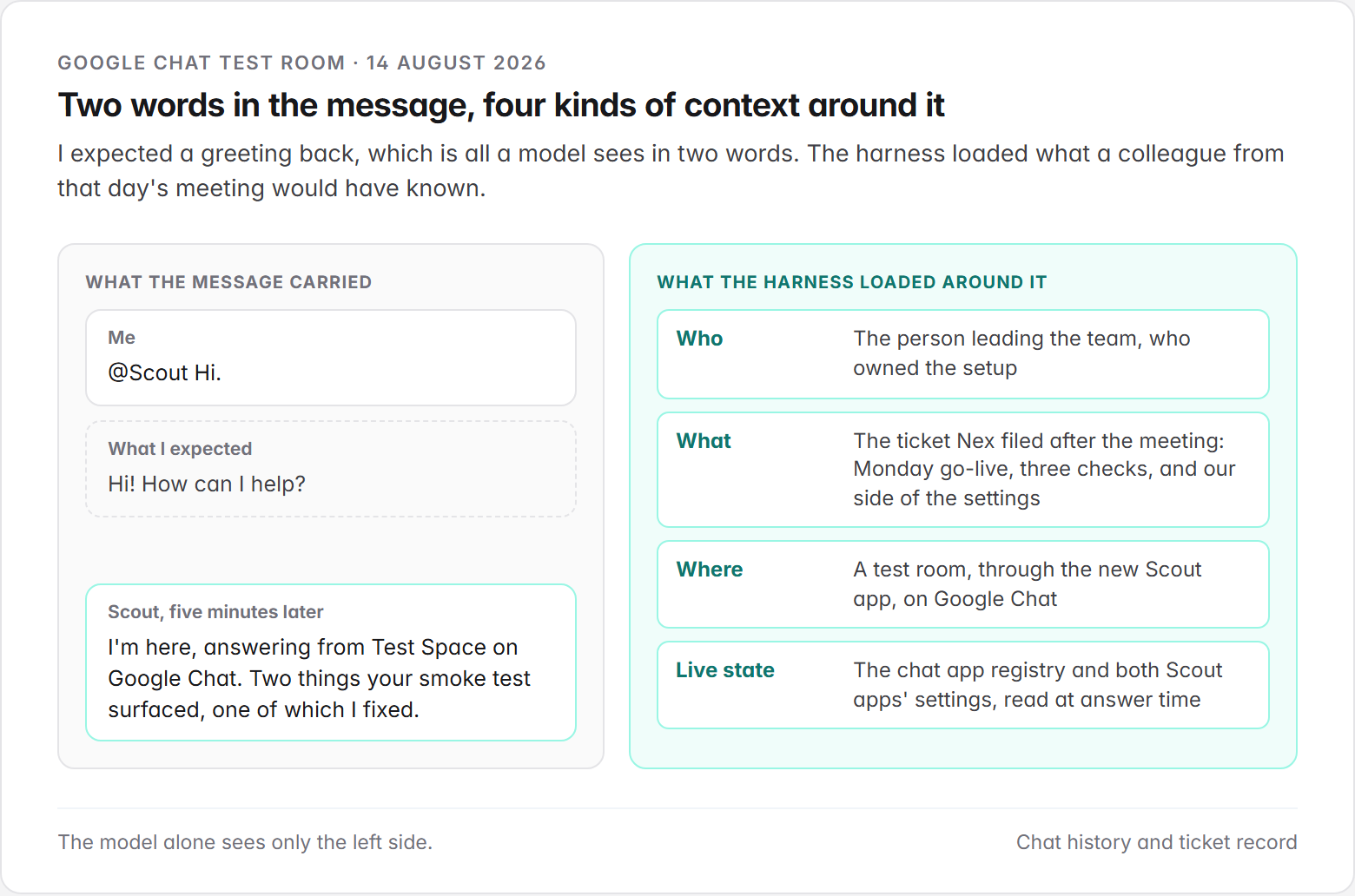
Scout knew four things that were not in the message. It knew who was asking: the person leading the team, who had set up the app that afternoon. It knew what was going on, because after the meeting Nex had filed the ticket for the Google Chat app itself, with the setup steps, the Monday go-live, three checks that would prove it worked, and a note that the settings on our side were its job. It knew where the message came from: a test room, through the Scout app, on the chat platform that app had just been registered on. And it could look things up in live systems, so it never had to guess whether the registration had landed or what the Slack app had pinned.
All of that comes from the harness, the software around the rented model. Memory is markdown in git, with a dated link to the evidence beside each note, and a task loads the notes that match the person, the project, and the kind of work. Tasks can propose new notes, and a nightly pass checks each proposal against its evidence before it becomes shared memory. Each room has a short contract file saying who sits in it and what it covers. Integrations reach chat, code, tickets, meeting notes, and data with the access a teammate would have. The bar is the context a colleague who sat in that meeting would carry into the room. That colleague would have read my hi as a test too.
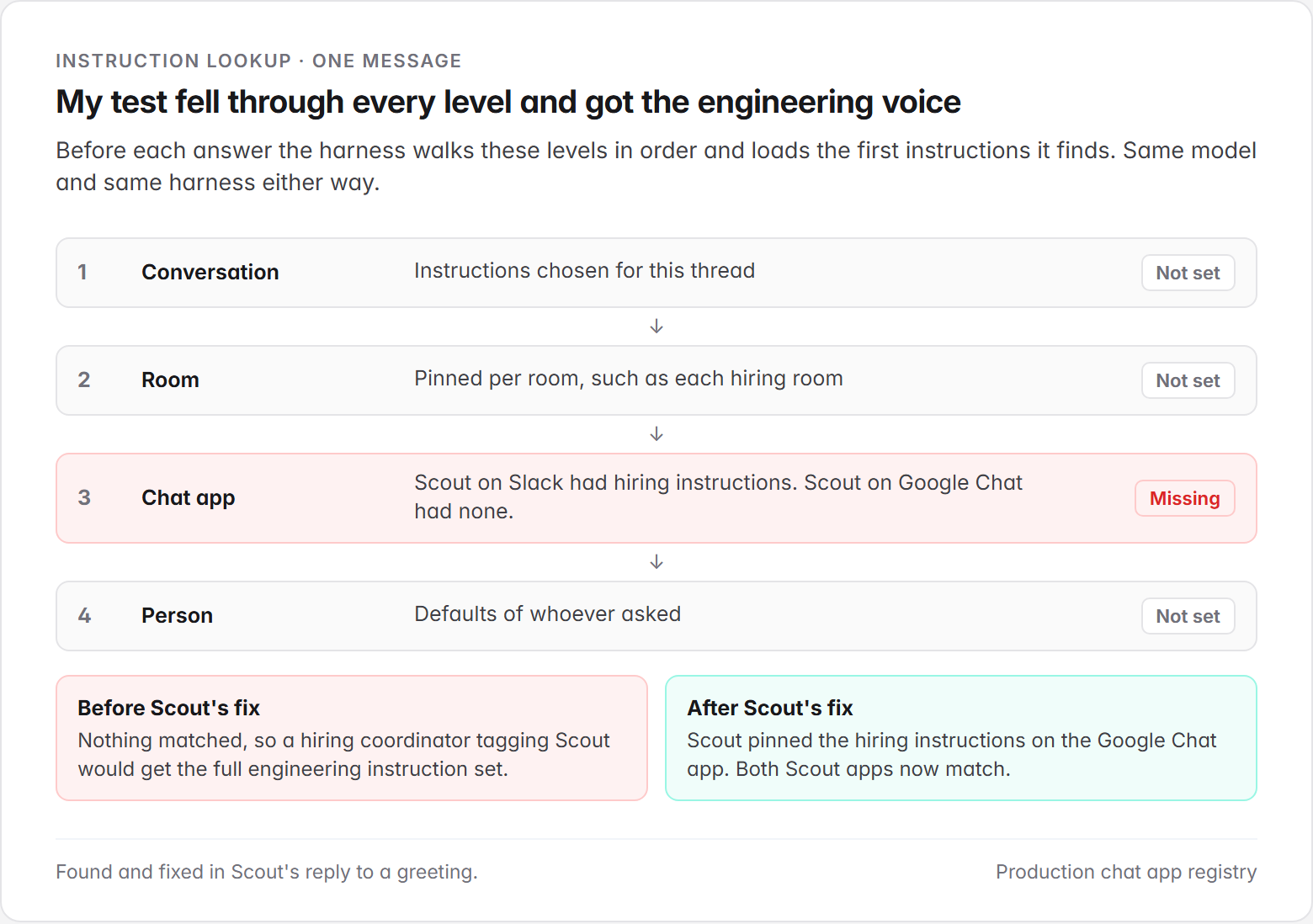
The gap Scout found makes the same point from the other side. Before every answer, the harness picks which instructions to load by walking a fixed order: the conversation, then the room, then the chat app, then the person. The first level with instructions set wins. My test room had none, and the brand-new Google Chat app had none, so my message fell all the way through and Scout answered me in the full engineering voice. Same model, same harness, same skills. The difference between a hiring assistant and an engineering bot in the wrong room was one empty setting, and Scout spotted it in its own reply to me.
Context also produced the one wrong claim in that reply. Scout said the message had been served by the default Nex app and not by Scout, because a field that records which app served a conversation was empty. It had even checked a control: a Slack conversation with Scout, where the field was filled in. The reasoning was careful and the conclusion was wrong. That field is only ever filled in on Slack, so on Google Chat it stays empty whichever app answers. The control came from the wrong platform.
I pushed back:
I tagged scout, you replied as scout.
Within minutes it pulled the message from Google Chat itself, saw that the sender was Scout, traced the empty field to the code that only sets it for Slack, and corrected the claim on the ticket and in its memory notes.
That mistake is the risk that comes with context. A fact that holds in one place and gets read as true everywhere is more persuasive than no fact at all, because it arrives with evidence attached. What fixed it was the same thing that made the first answer useful. The record was reachable, so my objection pointed at something Scout could check, and it checked instead of arguing. A model with no access to that chat history could only have apologized or insisted.
This is why most of our engineering time goes into context and not into the model. The model underneath is rented and gets replaced when a better one ships. A better model makes each answer somewhat better. A missing note, an empty setting, or a field read on the wrong platform makes the answer wrong whichever model reads it. Since go-live, close to fifty people on Crossover's hiring team have started over 400 conversations with Scout across around twenty rooms, and the answers they forward hold up because each room knows its own scope.
I sent two words and expected two back. What I got was what a colleague from that meeting would have said: it works, this was broken and is now fixed, and this one step needs you.