Entry 1 (19 to 25 Jan): Cutting a thousand-line spec down to the part a decision-maker reads
In the third week of January we were deep in the plan to rebuild a student information system. The spec had grown to nearly a thousand lines. It held the business case, a teardown of the current system, an evaluation of five commercial vendors, and a running log of arguments, all in one file. Every reviewer read a different slice of it, and nobody read the whole thing.
On 20 January one of our engineers restructured it. The main spec dropped to about a third of its length and opened with business impact instead of architecture. Compliance changes took weeks because onboarding lived in five places at once. We had built our own form builder and our own document signing, and both now cost maintenance time. Three systems disagreed about the same account, so finance checked every invoice by hand. The data model could not assign one customer to two plans, and the business needed exactly that.
Everything else moved out. The analysis of the current architecture and the vendor evaluation became two linked detail documents. The evidence log, the progress checklist, and the outline went into a working folder of over 1,500 lines that was explicitly kept out of the deliverable.
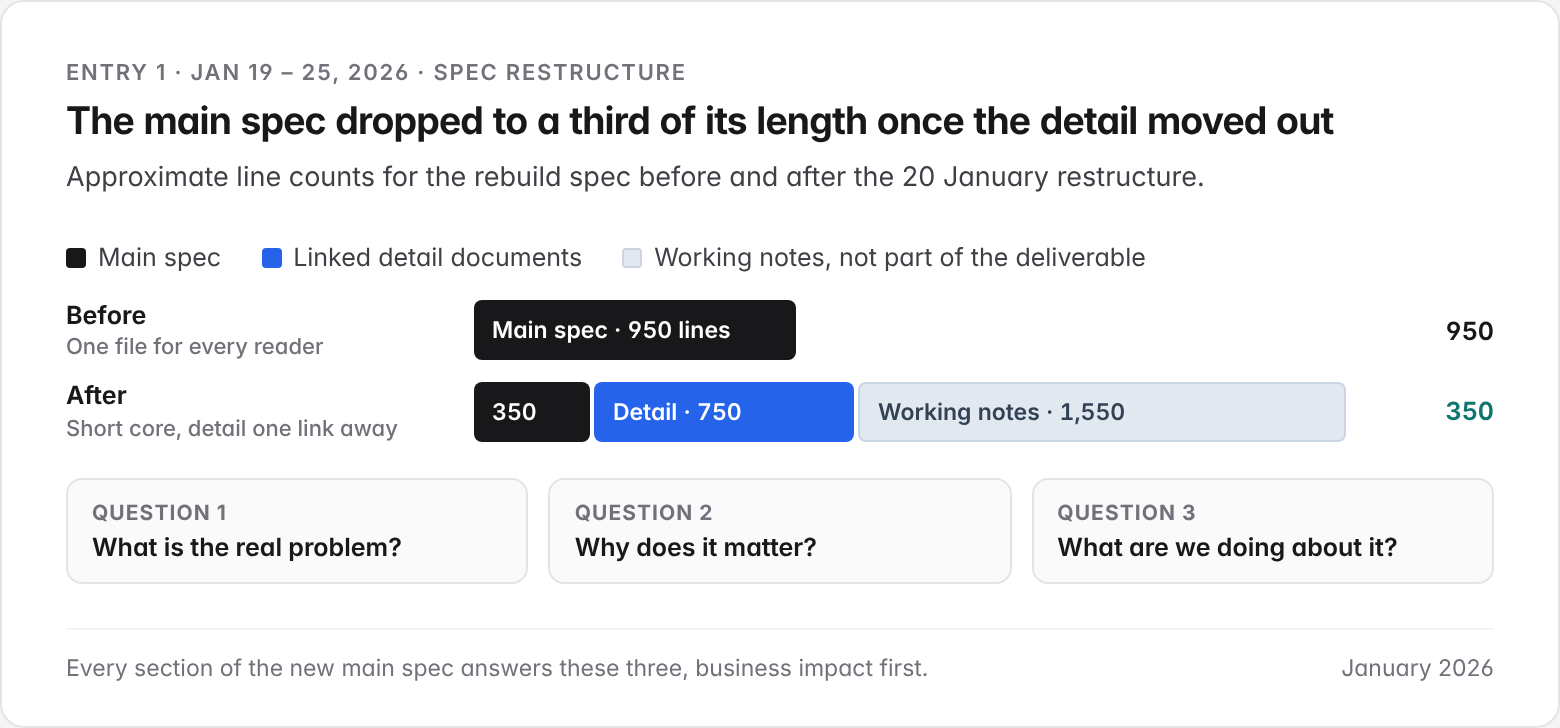
The split changed the review conversation more than the content did. With one long file, every round drifted into technical preferences, because the technical preferences filled most of the pages. The short version forced the question a decision-maker actually owns: is this problem worth the money? Engineers who needed the data model analysis still had it one link away, and it no longer stood between an executive and the verdict.
The outline that shipped with the restructure put business impact first and kept technical detail in its supporting documents. Every section answers three questions: what is the real problem, why does it matter, and what are we doing about it?
I had been writing specs as proof that we had thought of everything. This one taught me that a spec is a decision instrument, and the proof belongs in an appendix the decision-maker never has to open.