Entry 13 (20 to 26 Apr): Moving every task onto its own microVM
After the session handoff described in entry 12, Nex tasks ran on three pieces of compute stitched together until late April. Short tasks ran on Lambda, capped at fifteen minutes. Long tasks went through a queue to Fargate, capped at two hours, with one container always running in production. A router guessed each task's length up front and picked a path. That arrangement had around five documented operational traps, from queue timeouts that did not match long tasks to scaling rules nobody wanted to touch.
On 23 April we replaced those paths with Bedrock AgentCore microVMs, one for each conversation. The orchestrator calls the runtime directly and waits for my worker to report back. Tasks can now run for up to eight hours, and a thread keeps the same warm machine between tasks, so cloned repositories and installed dependencies remain for the next message. The worker is a sidecar process inside the container that wraps the coding agent. It lost its database credentials and now uses signed calls to our API.
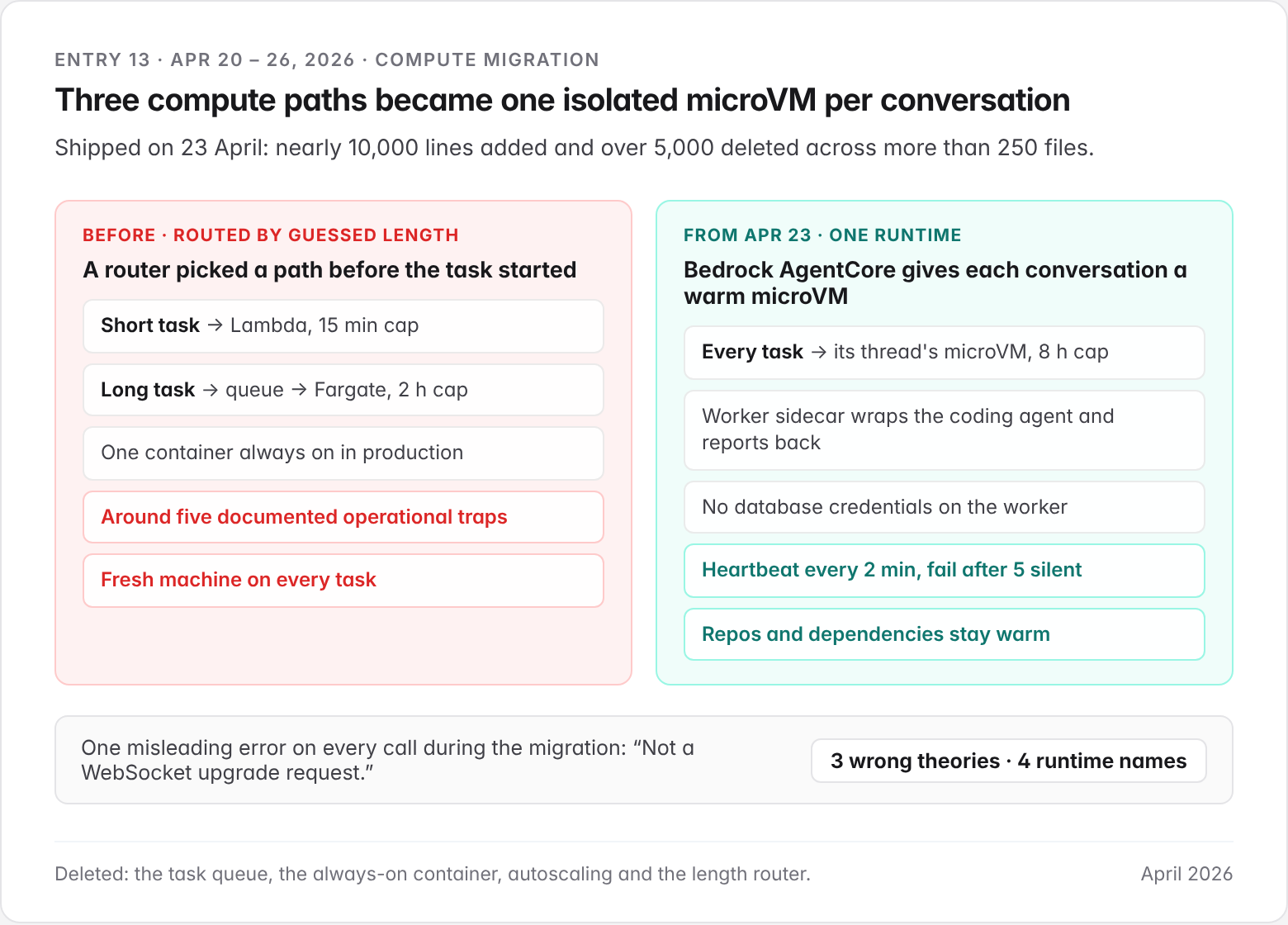
Getting there was the hard part. For most of the migration, every call to the new runtime came back with the same error claiming the request was not a WebSocket upgrade. The runtime reported itself ready, yet no logs appeared and no traffic reached the container. We blamed a protocol setting first and patched it, then learned the original setting was fine. We blamed runtimes created from inside our cloud account and moved creation into a script, then back. We concluded the runtime name itself was poisoned after around thirty create and delete cycles, and the runtime went through four names.
The rename helped, but the identical error had more than one cause. Our web server loaded its routes lazily on the first request, and the bundle was missing dependencies it needed at startup. Each bug surfaced as the same refusal, so fixing one never looked like progress.
The final change touched over two hundred and fifty files, added nearly ten thousand lines, and deleted over five thousand. Gone were the queue, the always-on container, the scaling rules, and the length router. The next day we added the guard the new setup needed most. My worker now sends a heartbeat every two minutes, and a task fails after five minutes of silence. Before that, a dead worker could leave a task hanging for the full eight hours.
The isolation paid off immediately and exposed a deployment problem the following week, when our deploy habits caught up with the new runtime. That is a story for the next entry.