Entry 25 (13 to 19 Jul): A false alarm that cancelled a human's approval
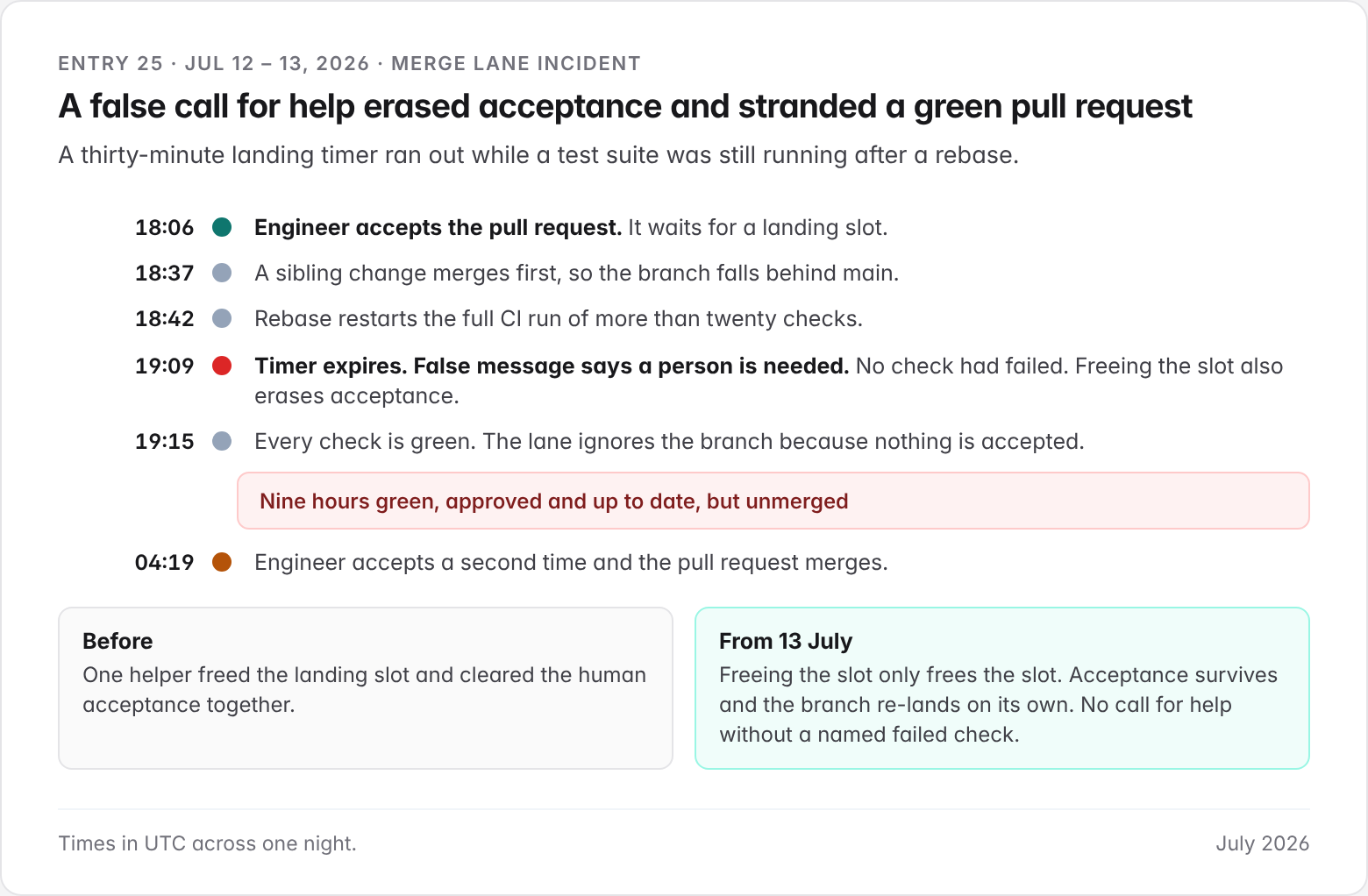
Serban accepted one of my Nex pull requests on a Sunday evening in mid-July. Half an hour later a sibling change merged first, so my branch fell behind main. I rebased it, and the rebase restarted the full CI run of more than twenty checks, which takes about twenty-three minutes on that repository.
Our merge lane gave a blocked landing thirty minutes before it decided whether a person was needed. That timer ran out while the slowest test suite was still running. The lane saw a merge that GitHub refused and posted a message saying the pull request had converged but could not merge and needed a person. It named no failing check, because none had failed. Six minutes later every check was green.
The false alarm was annoying, but the second half of that code path did the damage. To free the landing slot, the lane called a helper that also erased the human acceptance. So the pull request sat there, green, approved, and up to date, with no record that anyone had accepted it. The merge lane only lands accepted work, so it ignored the branch for nine hours, until Serban noticed in the morning and accepted it a second time.
This was the second false alarm from that lane in two days. The fix for the first one had shipped earlier that same day and covered a different path into the same message. That told us patching the classifier again would not be enough. The real flaw was that two unrelated decisions shared one function.
On 13 July we split them apart. Freeing the landing slot now only frees the slot. At that point, acceptance required a human act, and nothing the lane did on its own could take it back. A branch that gives up its slot keeps its acceptance and lands automatically once the block clears. We also made it impossible for the lane to post a call for help without naming the check that failed.
The deeper lesson took two more weeks to act on. A fixed timer was trying to answer a judgment question: is this check about to pass, or does a person need to see it? Rules keep getting that wrong in both directions. They wait through states a human should see, and they escalate states that would have resolved on their own. At the end of July we moved that call out of platform code entirely, leading into the landing change in entry 27.