One release a day
For a decade the gold standard was simple. Every merge goes straight to production, in small changes, rolled back in minutes. I believed it and I ran teams that way. Once AI started writing most of our code, I went the other way.
Our merges now land in a pre-production environment, and production gets one release a day. Since early September we've cut around seventy of them. An average release carries about twenty merged changes. After a weekend or a skipped day it can carry around fifty.
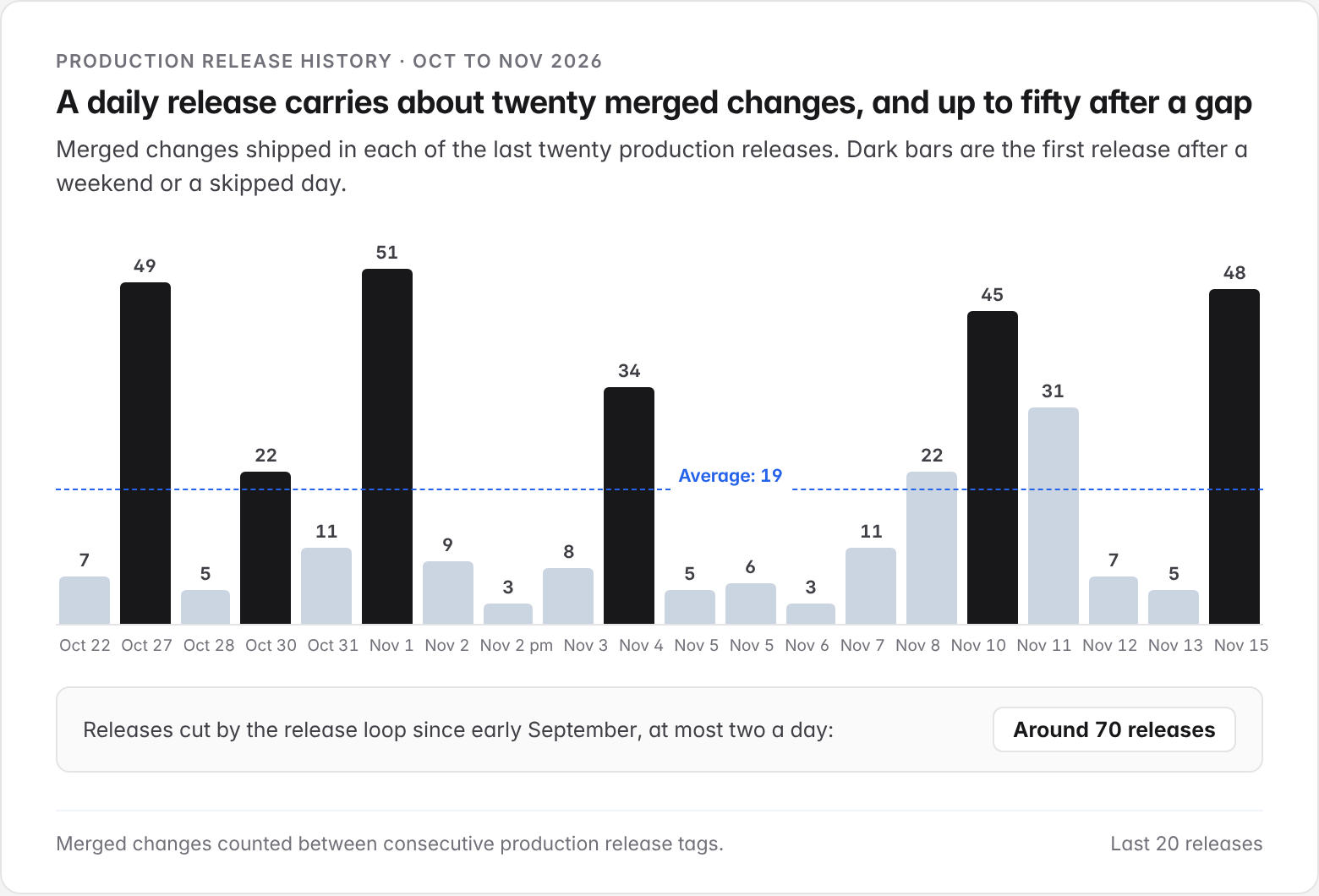
Continuous deployment was designed around a human rate of change. An engineer merges a few times a day, knows exactly what each merge does, and watches the dashboard after it ships. If something breaks, the person who wrote the change is the person looking at the graph, with the diff still in their head. That loop is what made continuous deployment safe. The pipeline only automated the button.
AI breaks that loop. Our agents merge around a thousand pull requests a week across a twenty-person team. Nobody watches a graph after each one, and nobody holds a thousand diffs in their head. Shipping every merge straight to production at that rate becomes an uncontrolled trickle. The product changes underneath your users every few minutes, and when something goes wrong you're bisecting a stream nobody observed.
Some teams react to AI volume with a monthly train, a change advisory board, or a freeze before every launch. Those controls make the batch bigger. Bigger batches carry more risk, and that risk encourages teams to release less often. Within a quarter they may ship once a month and still break things, because a month of AI output is too much to reason about at once.
One release a day sits between those two. The batch is small enough to read over coffee and big enough that a human actually looks at what ships.
For Nex, that human is mostly me. WS.Eng builds several products in parallel, and Nex is a side show among them. I use Nex every day as a regular user, on the pre-production environment where merges land first. This is a sanity check on the release batch, not manual acceptance of every ticket. If something is badly broken, I see it before our users do.
Human attention belongs on decisions the evidence cannot settle, such as how a feature feels for an actual user.
What surprised me is how little of the release itself needs a person. We cut the first two releases in September by hand. Both times we rewrote the checklist from memory, and both times we had no standing signal that the release had actually worked. So we handed the cut to an agent loop.
Every morning at the start of a quiet window, a release thread wakes up and asks one question: can we release right now? Yes pins a single commit and ships it. No sends me one message explaining why, and the day ends there. Maybe asks again an hour later, with another check at the end of the window. Merges that land after the pin wait for tomorrow. Because the release is one pinned commit, everything that ships was tested together, and any approval binds to exactly what goes out.
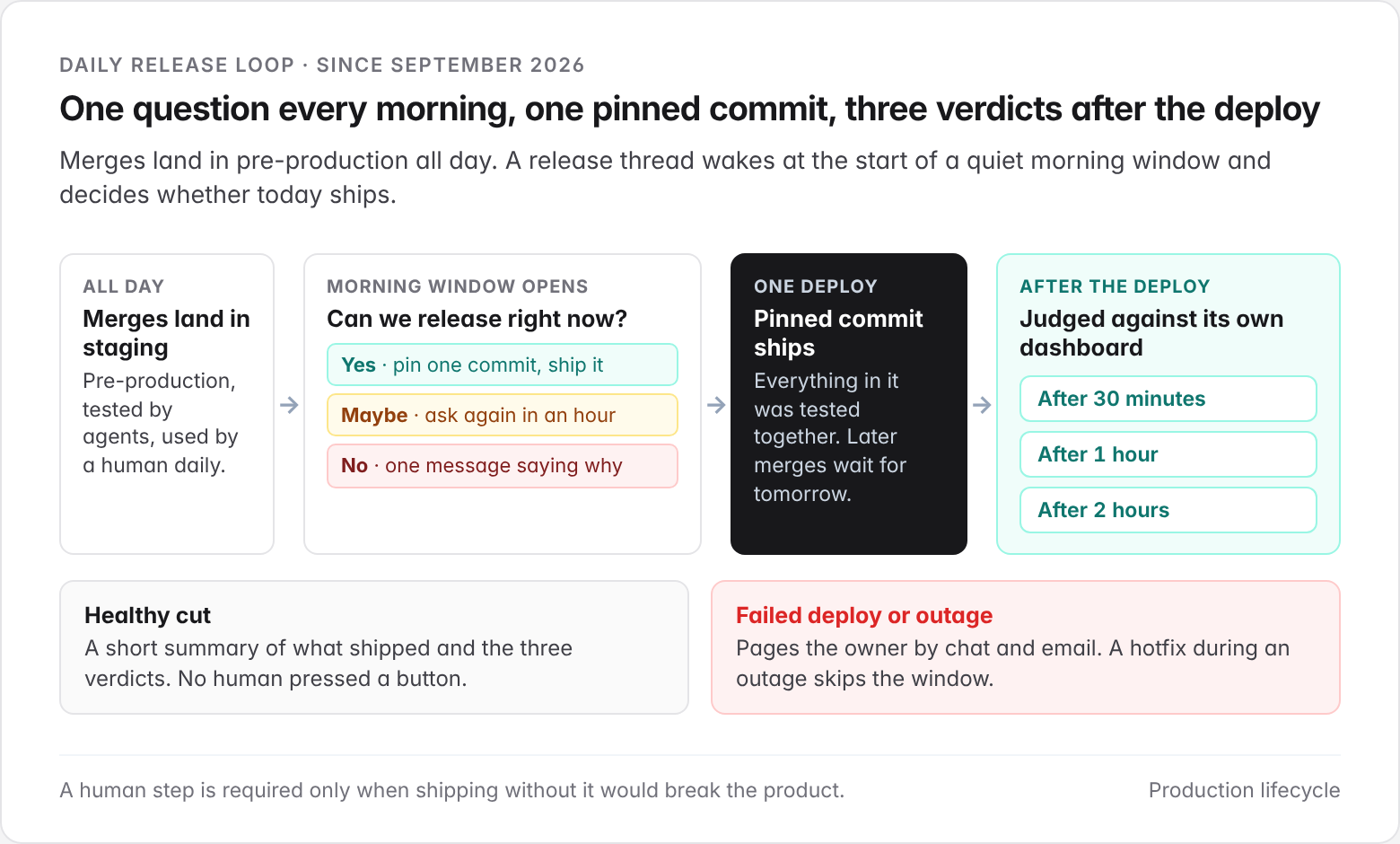
A green deploy only starts the verification. Thirty minutes after it finishes, the loop judges the release against its own dashboard, then again at one hour and at two. A healthy cut ends with a short summary of what shipped and the three verdicts. A failed deploy or a real outage pages me by chat and email. I only get pulled in for a hotfix during an outage, or for a manual step whose absence would break the product. Nobody presses the deploy button on an ordinary day.
This is what makes a daily batch cheap. The fear around batch releases came from the manual ceremony. Someone had to coordinate, someone had to watch, and someone had to decide. Take the ceremony away and a daily release costs nothing but the wait. A fix merged at noon reaches users the next morning unless it's a hotfix. For a SaaS product people use during working hours, that's a good trade. For an outage, we skip the window.
I don't see this as permanent. Every guardrail we add catches something that used to need my eyes, and each one shrinks the batch a human needs to look at. When our automated checks judge a visual regression as fast as I do, the batch gets smaller and releases get more frequent. Airplane software needs a different release process. For a regular SaaS product built by agents at a thousand pull requests a week, one release a day keeps production changes in a batch I can check each morning.