Where the human review went
Early this year I wrote that the difference between vibe coding and real engineering is that I look at what the AI generates. Ten months later, I don't read diffs line by line anymore.
Our lean new-products engineering department builds several products in parallel. Nex is one of them. It started as my side project, and it still is one: I work on it in my spare time, alongside the team.
On our platform, the AI merges around 1,000 pull requests a week across a twenty-person engineering team, with weekly diffs averaging around 800,000 lines. Split across twenty engineers, reading every diff means 40,000 lines per person a week, or 8,000 lines every workday, before anyone designs a feature or touches their own vertical. There is no version of that where I read every diff.
Measured over one week of merged Nex-authored pull requests, each credited to its owning engineer, about a fifth of the engineers shipped over half of the work. The top half shipped most of the rest.
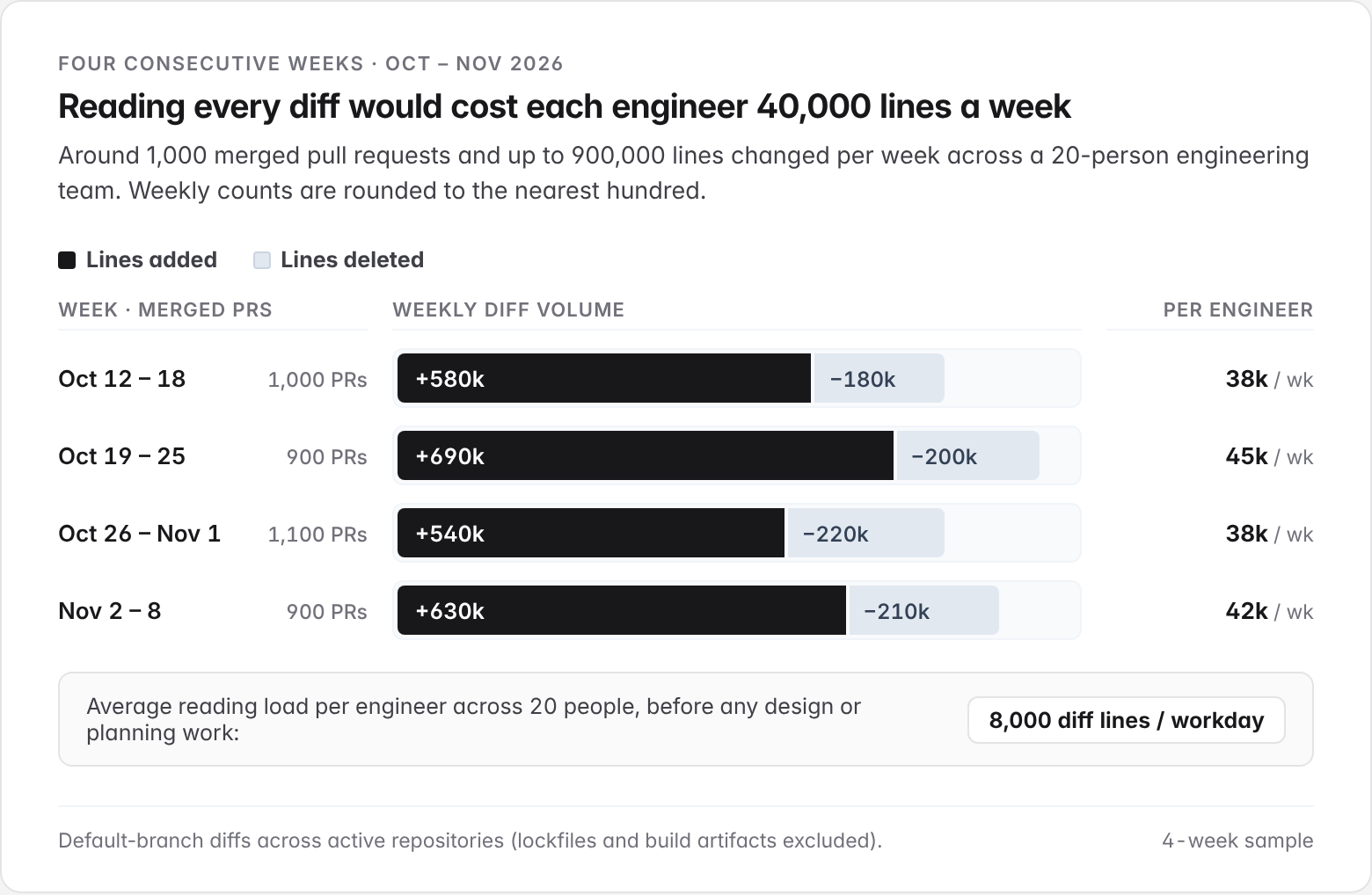
Volume only exposed a deeper problem. Code review worked because the reviewer also wrote code in the same repository every day. Every review taught you something, and your own hands-on context let you catch subtle bugs fast. Once nobody on the team writes code by hand, a reviewer is staring at what someone else's AI generated in a codebase neither person works in line by line. When we checked our own review history, we were rubber-stamping pull requests without a single comment. Worse, spending hours a day parsing machine-generated diffs is miserable work for a strong engineer.
So we stopped treating a single diff gate as protection. We automated implementation checks and reserved human attention for decisions the evidence cannot settle.
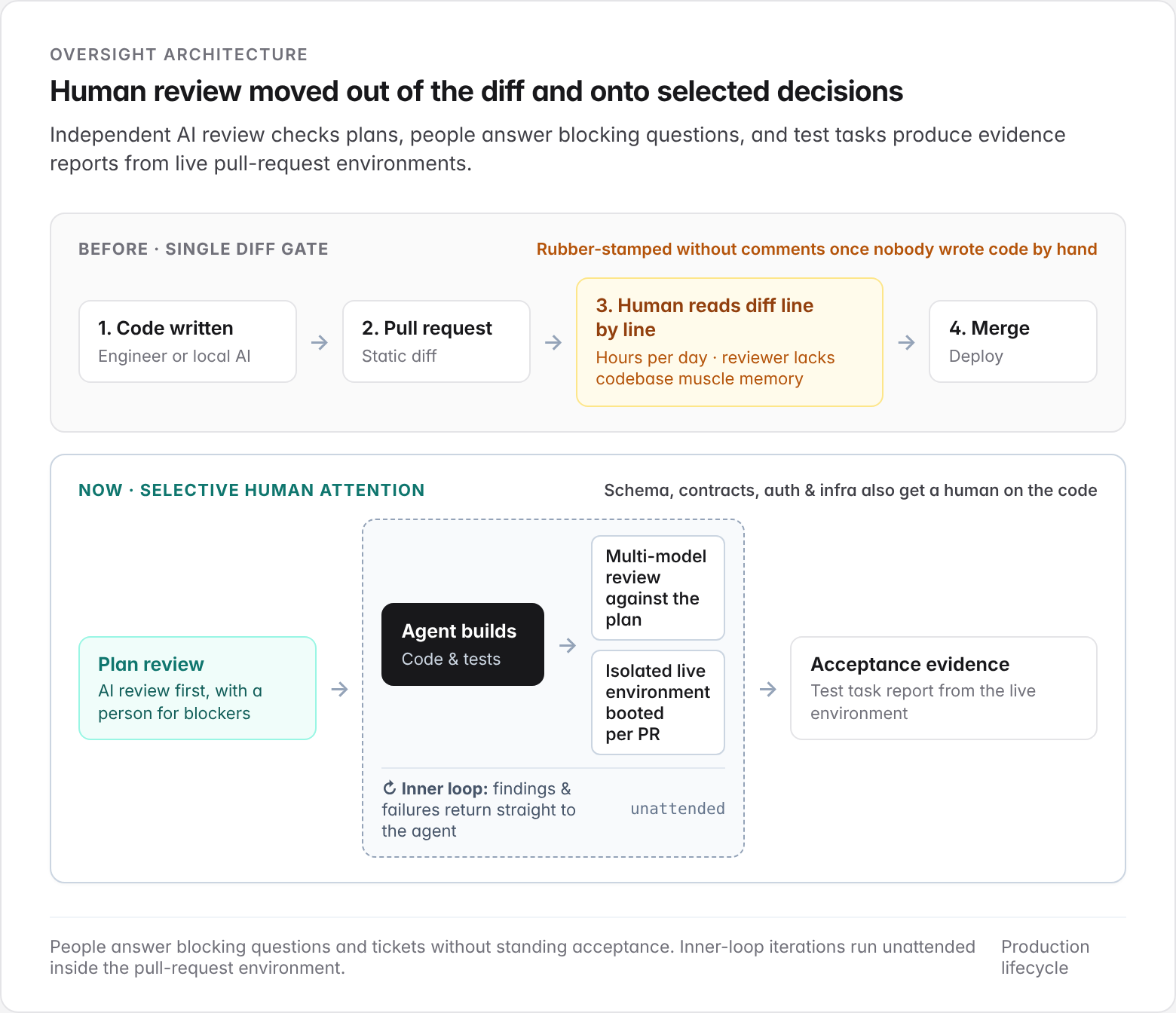
Before code gets written, an independent AI review checks the plan. Work proceeds unless the plan raises a blocking question. I do not read every plan, and I read the ones I choose to read. Catching a bad direction late costs the code and tests the agent wrote in the background, then requires a re-plan.
Independent AI models review the implementation against the plan, while an isolated, production-like environment boots for that pull request. The agent can run and break its work there before the test task runs the planned scenarios.
Automated reviewers fail silently too. In June we fixed a configuration loader bug that had collapsed our four-model review panel onto a single model. For weeks we thought four independent models were checking each branch when one model was grading itself. Guardrails are software, and they rot the moment nobody tests them.
At the end, a test task runs the planned scenarios against the live pull-request environment and produces an evidence report with screenshots, video, transcripts, or logs. A ticket covered by a standing grant or a repository acceptance rule is accepted without me, and I rarely check the product by hand. In August an agent moved a ticket across our project board, and our backend treated that column change as human sign-off. Two changes merged without acceptance, so the next morning we restricted acceptance to one path with human provenance.
Changes that touch the data model, external contracts, permissions, or infrastructure still get a second engineer on the code itself. Routine work proceeds when the checks pass and the live environment supports the evidence report. Independent plan review, multi-model code review, and per-pull-request testing give each change several checks. Engineers with deep system context design and audit those checks.