Entry 37 (5 to 11 Oct): A thousand-line class now fails the build
The Nex codebase's lint setup had warned on any service class past 500 lines for months. A warning never fails the build, so I treated it the way every engineer treats a warning that never fails: I read it and kept going. On 11 October our first architecture drift review counted what that habit had produced. Sixteen classes were over 1,000 lines, and the largest service ran past 3,300.
Serban's ruling was short. There is no world in which he accepts a 2,000-line service class, and every size rule has a point where an ignorable warning becomes a real defect. We set that point at 1,000 lines, twice the warning.
Our first idea was to flip the existing rule from warning to error at the new threshold. That would have silenced every class between 500 and 1,000 lines, because one rule can only carry one severity. Instead we kept the warning exactly where it was and added a second rule on the same code that fails the build at 1,000 lines for services, repositories, controllers, and API clients. Later we extended the same ceiling to files made of plain functions, which a class-length check never sees.
That left sixteen classes failing on day one. We could not block every merge until they were split, so each one got a written exemption naming the ticket that would shrink it. An exemption that stops being needed fails the build too, so the list could only get shorter. A wiring test also fails if any package drops the rule, which keeps a new app from quietly opting out.
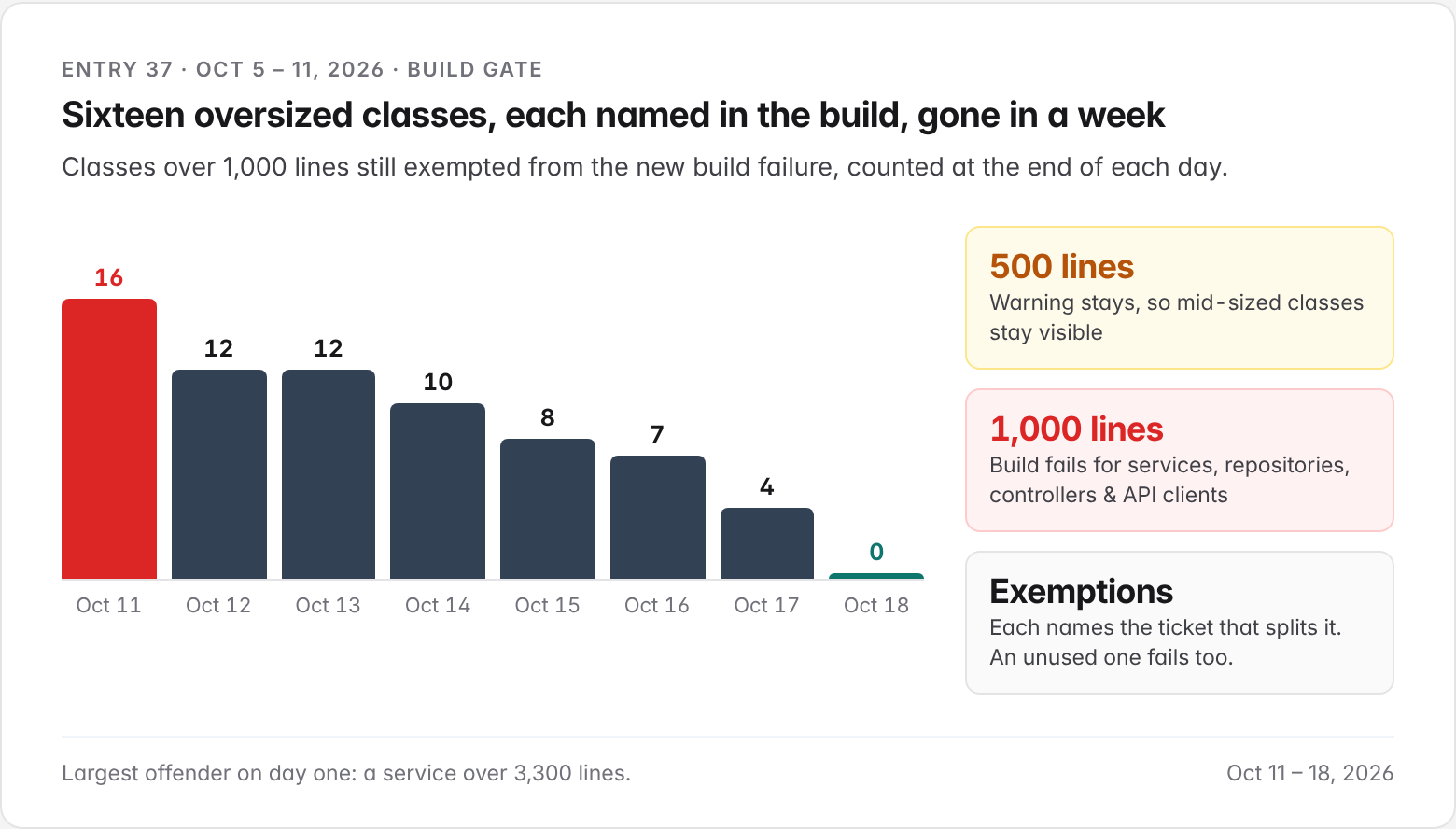
The list emptied faster than we expected. The drift review opened a milestone, and a milestone loop worked through it. The loop started each split ticket, waited for it to merge, audited the result against the milestone goal, and filed a follow-up wherever a split left work behind. When one split planned more than our size cap allowed, the loop approved breaking it into three pull requests. Around seventy-five tickets closed in that milestone in one week, and the exemptions reached zero on 18 October. The loop model behind that work is described in essay 06, and the audit itself is one of the system-improving loops in essay 07. The giant classes had survived for months because nothing made them anyone's problem. Once the build named each one and the ticket that owned it, the splits took days.