Entry 36 (28 Sep to 4 Oct): Grading our summary prompts on twenty real past turns
My long Nex threads were outgrowing the model's context window. A ticket that runs from plan through build, test, and review piles up every tool call and file read from every step, and by the late stages most of what I carry is history I no longer need. The obvious fix was to summarize old steps automatically. Our first instinct was to write one good summary prompt, build the compactor around it, and tune it in production.
Serban stopped that on 4 October. He wanted to see the prompts run against real history before any compactor existed, and to keep dry running them until we were happy. So the first thing we built was a replay tool instead of a compactor.
It pulls a stored conversation, splits it into turns, matches each turn to the task that produced it, renders the summary prompt for that kind of task, and sends it to one fixed summarizer model. The output is a side-by-side report covering what the turn actually did, the summary it became, the size before and after, and what the summary cost. We ran it on twenty hand-picked turns, five each of planning, building, testing, and general requests, spread across several repositories and thread kinds.
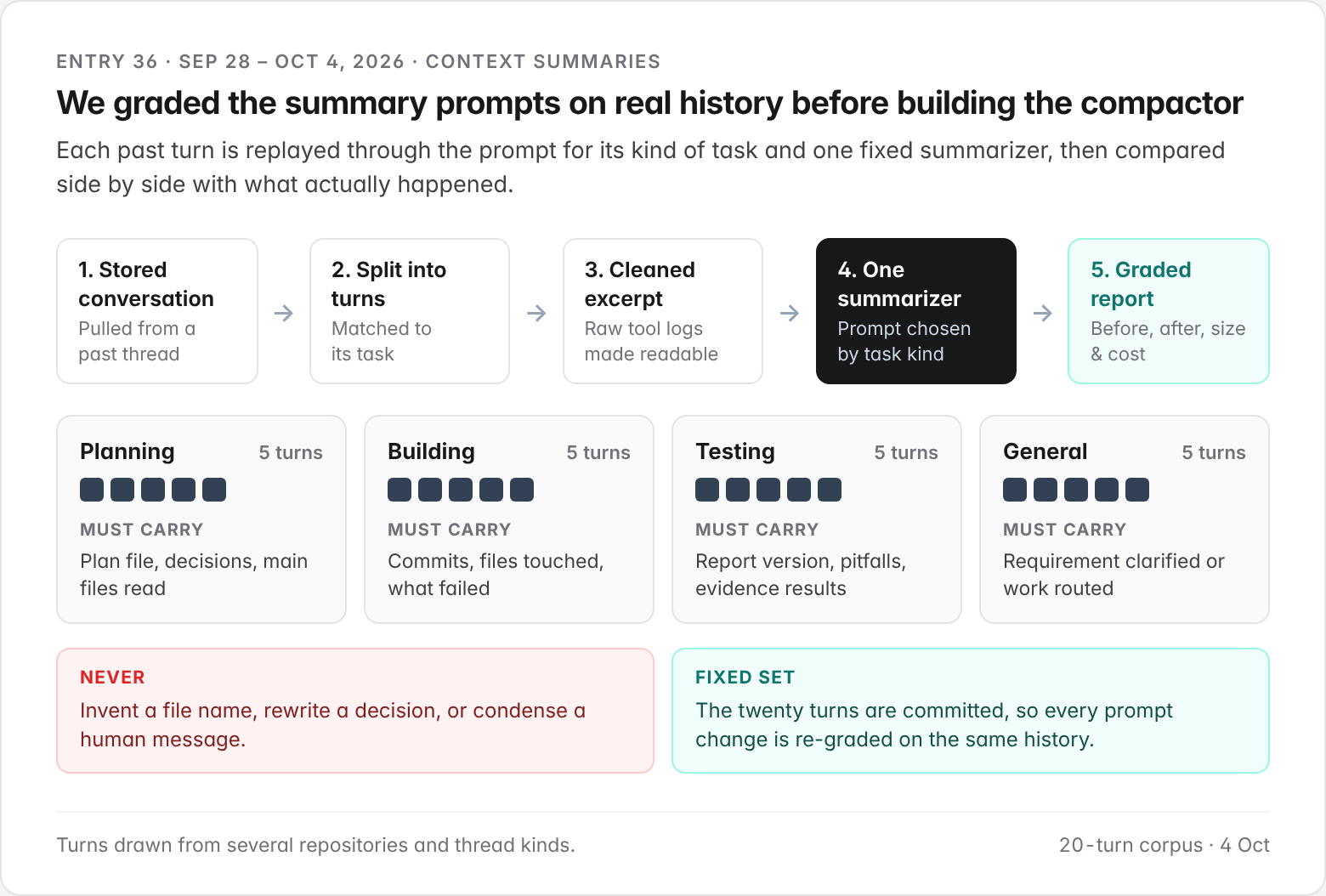
The first report showed raw tool output going straight to the summarizer. Serban asked why we were sending it unreadable machine logs, and cleaning each turn into readable form became part of the same change. The grading then set what each kind of summary must carry. A planning turn keeps the plan file, the decisions, and the files it read. A build turn keeps its commits and what failed along the way. A test turn keeps the exact evidence report version and which scenarios passed. No summary may invent a file name or rewrite a human message, and human messages are never condensed at all.
We committed the twenty turns alongside the tool. Two days later we added five more turns from long-running project threads and gave those their own prompt, and every change since gets graded against the same set. This work belongs to the deeper context story in essay 08, where preserved history lets a system respond with useful project context.